Heathcliff’s soul and mine are the same. But I pray he’ll go away, the sullen misfit!
Can you imagine the women in Jane Eyre and Wuthering Heights responding to their deep, dark, mysterious men in those terms?
What would Emily and Charlotte Bronte’s most celebrated works be without the romantic love of a misunderstood anti-hero? If they’d shown men as they really were, would their novels have become such classics?
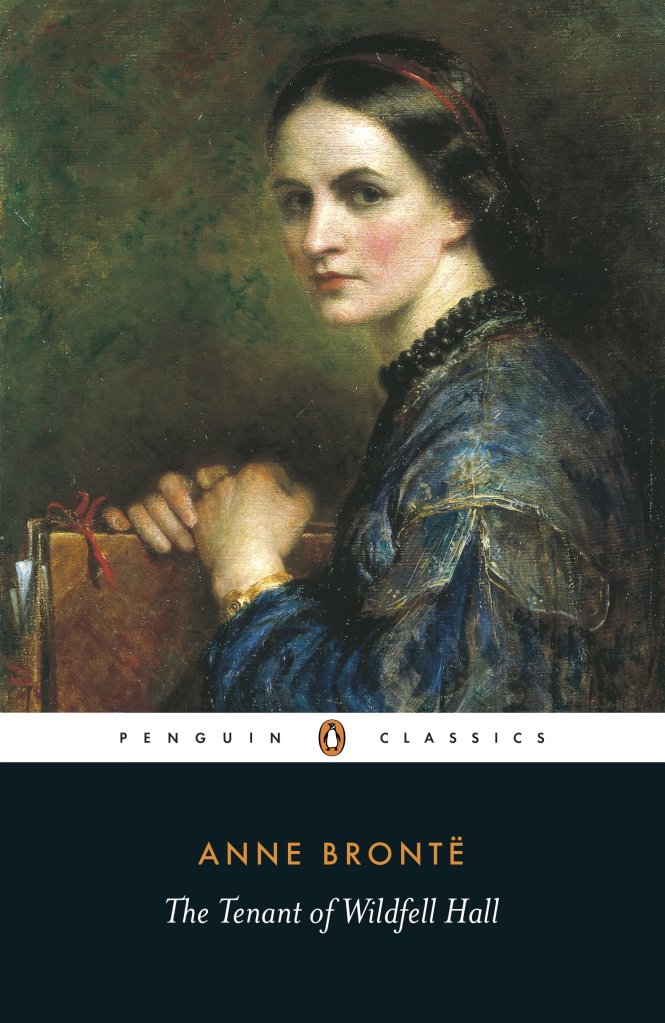
Step forward the third Bronte, Anne. (There were 5 sisters in all; 2 died as children.) She wrote just 2 novels, one more than Emily and two less than Charlotte. I’ve just finished her second book, The Tenant of Wildfell Hall (1848).
I picked up on it from a Melvyn Bragg In Our Time broadcast last September, which suggested Wildfell Hall is the first feminist novel.
The main story is framed by a conventional romance between a young farmer, Gilbert, and the mysterious tenant, Helen. No Rochester, nor Heathcliff – here, it’s the woman whose enigmatic past is key to the narrative.
The core of the novel is much darker, showing – in unflinching detail – Helen’s struggles with an abusive, alcoholic and unfaithful husband, Arthur. Against her highly moral, better judgement, Helen falls for him, hoping she can correct his boorish ways.
But he just gets worse, hunting, partying and bolting to London to screw around. He becomes increasingly violent with his dogs, servants and Helen herself. Tired of her attempts to refine him, he literally throws the book at her.
The arrival of her son, young Arthur, only makes things worse; as he grows up, his father forces him to drink and swear, just like daddy. Helen’s determination to save her son toughens her to defy convention: I’d rather he died than be brought up a man of the world.
Arthur humiliates Helen, brazenly parading his infidelity in front of her. Bronte shows mercilessly just how trapped she is – though selling her paintings helps Helen survive the unrepentant Arthur.
Anne Bronte’s depiction of domestic violence goes deep – the couples who visit Arthur and Helen are unhappily wed, with a nasty hint of just you wait till we get home from some of the brutish husbands.
Not all the men are bastards – 2 of Arthur’s badly behaving pals reform. As for Gilbert, he’s mostly meek; it’s Helen who coaxes him to maturity.
The Brontes had to adopt men’s names (Currer, Ellis and Acton Bell) to get published. It was still as Acton that Anne wrote her defensive preface to the second edition: Is it better to reveal the snares and pitfalls of life… or cover them with branches and flowers?
This was her defence against the torrent of criticism against the novel’s coarseness. It was judged unfit, revolting and disgusting by contemporary critics (all male, of course). Even Charlotte called the subject of her sister’s best-seller an entire mistake whichthe author was not qualified to handle.
Anne had, at least, the consolation of popularity. That second edition was due to Wildfell Hall selling even faster than Jane Eyre had. Jalouse, moi? – as the francophile Charlotte might have said.
The first feminist novel? You could claim that Wildfell Hall’s theme – intelligent woman denied opportunity by patriarchy – echoes Mary Wollstonecraft’s A Vindication of the Rights ofWoman (1792). But Anne was writing from her own imagination and observation, if not experience.Like Emily and her brother Branwell, Anne never married, though she saw, at first hand, Branwell’s drinking and affairs.
The Tenant of Wildfell Hall is a brilliant read because it’s so vivid – the story intricate, the characters authentic and the situation compelling. Until recently, Anne’s books haven’t attracted the kudos of her sisters’.
When you hear of the Met policeman writing to a female officer:I’d happily rape you and countless examples of disgusting misogyny in 2022, you realise that Anne Bronte’s evocation of male domination, and women’s struggle to break it, seems more urgent than ever.
Since 2008, Scot Goes Pop! has effervesced as the pro-indy opinion pollster. But, with a flawed survey on gender reform and the promotion of Alba beyond its vote share, has James Kelly’s blog lost its sparkle?
Done right, opinion polling is an accurate science with strict rules about sample size, selection of participants and margins of error.
– Dave Roos How Political Polling Works
(A version of this blog post is published on Bella Caledonia: https://bellacaledonia.org.uk/2022/01/31/scot-goes-off/ )
Are opinion polls objective? You can’t argue with numbers. If a poll shows a greater percentage in favour than against, doesn’t that prove the more popular option?
In the case of Scotland’s future, it couldn’t be simpler: literally a Yes/No question.
Yet unionist media interpret polls according to their own political tilt. Last April, the Sunday Times was disappointed at its Panelbase survey which showed nationalists on course to win a supermajority. The recent 55% Yes from Ipsos Mori was headlined by the Daily Express as not necessarily indicative of what’s going on.
The BBC, who claim to report trends not single polls, pronounced a No lead decisive,but played down the run of Yes majorities throughout 2020. In 2017, Ruth Davidson crowed over a supposed 60% against indy, based on a ridiculously leading question, phrased to beg people to say “no”.
Step forward, Scot Goes Pop! The pro-indy blog, run by James Kelly, is a corrective to the slew of No-friendly papers and broadcasters. The site doesn’t pretend neutrality – instead it steers a forensic analysis of polls, parties and press.
As well as reporting and interpreting results, Scot Goes Pop! drills down into the methodology – probity of the questions, weighting of the samples, how and when the poll was run and who by.
More, Kelly has an exhaustive grasp of different electoral systems. Defying flak, he’s made it his job to explain how Scotland’s voting schemes – first past-the post, d’Hondt and STV – work in practice.
When he thinks there’s a gap – say, a long while since Yes/No has been tested – Kelly crowdfunds and commissions Scot Goes Pop’s own research, giving the initiative to a pro-indy voice.
Last October, SGP’s political journey took an interesting turn when it commissioned a poll about gender reform. Past SGP! pollsfocused on independence and related matters, like a plan B for indy, Brexit and the handling of the pandemic in Scotland and England.
While the questions on voting etc. are short – as few as 9 words – the gender questions are long, up to 155 words. Some are hypothetical. Others ask respondents to pick the most persuasive from a range of set answers.
According to Kelly, his poll asks straight-down-the-line questions. But is that true of this one, for example?
If a woman requires an intimate medical examination after being sexually assaulted, do you think she should have the right to ask to be examined by a doctor who has been biologically female since birth, or should she only have the right to ask to be examined by a doctor who is legally regarded as a woman, regardless of that person’s biological sex at birth?
How likely is that situation to actually play out in the way this question supposes? Does it reflect reality, or is it phrased to evoke an uneasy reaction in respondents’ minds as they try to answer?
The questions and answers on voting etc. are straightforward (Which party will you give your first preference vote to?) and give the respondent a choice from simple responses (yes/no/don’t know/wouldn’t vote/a political party).
The gender questions are circuitous. They start with a contentious point-of-view (Some people argue that…) and end with an open question (Which point of view do you find more persuasive?). The set options are not the respondent’s own and use emphatic phrases like it is wrong; should and it is unacceptable.
Some of the gender questions set up a split between two strongly worded points of view. For instance:
Some people argue that it is bigoted or transphobic to ‘misgender’ a transgender person – for example to refer to them as ‘he’ or ‘him’ if their preferred pronouns are ‘she’ and ‘her’. Others argue that forcing people to use particular pronouns when referring to a transgender person is an unacceptable attack on free speech. Which point of view do you find most (sic) persuasive?
So, on the one hand bigoted or transphobic, on the other forcing people and an unacceptable attack on free speech. But do these stark terms chime with the natural impulses of people trying to use the right word? Again, the question bludgeons real-life experience into hard-line contrast rather than engage respondents in a thoughtful and authentic reply.
In answer to that question 29% said they didn’t know. Don’t know responses to the gender questions are strikingly higher than the number of neutral replies to voting intentions. (There’s no well, it’s a complicated issue, it depends option!).
Previous SGP! polls raised the money needed fairly quickly, yet – despite constant appeals on the site – funding for this one sticks at just over £4000 of its £6500 target, 3 months after it was run. Kelly used his own money to cover the shortfall. Future polls won’t happen until the funding is fully nailed down.
Kelly describes running this poll as an extremely stressful and bruising process.
He says he’s heartbroken by the way the SNP leadership’s obsession with this issue has needlessly opened up a rift in the independence movement. He claims his poll on this thorniest of questions aims to point the way to a much-neededresolution.
As if this particular Gordian knot could be untied by 9 loaded questions!
Summing up the results, Kelly writes: The Scot Goes Pop/Panelbase poll has convincingly demonstrated the public are strongly opposed to gender self-ID.
I, for one, am not convinced.
Another interesting turn in Scot Goes Pop’s political journey came in March 2021. Kelly, antsy (like many of us) for indyref2, quit the SNP and joined Alba. In September, Kelly was elected to the new party’s national executive committee.
This isn’t just personal. The site has long weighed the case for another party to spur the SNP. It charted the fortunes of the Scottish Socialist Party, Solidarity, Rise and others trying for electoral success in the Scottish parliament. Only the first, led by pre-perjury Tommy Sheridan, managed it.
Since 2003 – apart from the SNP, the Greens and individuals like Margo MacDonald and Dennis Canavan – no pro-indy group has won representation at Holyrood.
Scot Goes Pop! has consistently argued that such a party needs one thing to make a breakthrough: a weel-kent face.
Step forward, at the eleventh hour, Alex Salmond. In the 7 weeks between its launch and the 2021 Holyrood election, Alba got plenty of coverage on SGP!: Alba ascendant on course for 6 seats. Campaign hard and make sure that Alba reach at least 5%. Seven good reasons to vote Alba.The site urged its co-belligerent,Wings Over Scotland, to stop wasting time on trans rights and campaign for Alba.
Alba won no seats at Holyrood. Its vote share was 1.66% of the regional list. The low result may in part be due to Alex Salmond’s exclusion from all 5 TV debates; SGP! argues that outcomes hinge on these set-pieces.
Despite the setback, the blog thinks it would be realistic to persevere and pressurise the SNP because Alba boasts two MPs and a good number of local councillors. But all these were defections from the SNP, none elected under the Alba banner.
Kelly stayed open towards his former party, urging people to vote SNP on the constituency ballot, an attitude unreciprocated by Scotland’s dominant party. The SNP ignored Alba. Or, in some cases, spat venom at it.
Now, nine months after the Holyrood vote and three before local government elections, SGP! still thinks Alba could be a mainstream party.
He’s surely right in seeing space – and need – for forces more radical than the SNP, in power for 15 years and with enough to do keeping the show on the road.
Maybe such forces could come from a schism in Scottish Labour who finally realise how dead-end their party’s position has become. The grassroots independence movement, wings clipped by Covid, might produce a group to stiffen the SNP’s resolve.
But a party led by Alex Salmond? Whatever your view, there’s too much baggage. Perhaps if a less Marmite figure – say, deputy leader Kenny MacAskill – took over, the party might cut through, but, as things stand, it’s hard to see how Alba will gain many council seats.
As a seasoned pollster, is Kelly’s optimism an accurate reflection of the likely results? Or is he kidding himself?


 STAGE LEFT