We fictionalise to reach a truth. – J. G. Ballard
Scotland is rich in writing talent and novels about its history. These are some books I’ve enjoyed recently, by way of recommendations for summer reading.
Scents and Sensibility
Edinburgh. Two hundred years ago. Huge trees are moving from Leith Walk to Inverleith, worried along by head gardener McNab. The Botanic Gardens are growing, efflorescent like the city. Sir Walter Scott busies himself, preparing for the much-hyped, but still unconfirmed, visit of King George IV.

On to these shoots of true life, events and people, The Fair Botanists (by Sara Sheridan, Hodder & Stoughton, 2022) grafts two bright, invented characters who drive the plot – love, flowers, perfumes and secrets.
Elizabeth, a widow newly arrived in Scotland, and Belle, smart courtesan, share a fascination for the Agave Americana, one of the rarest plants in the world, due to flower any moment in the Botanics. Elizabeth wants to capture it in paint, Belle as perfume. Their stratagems to make their way in the capital, despite its sexism and conformity, are gently unearthed.
The book conjures a sensual array – colours, smell and tastes – to reveal the changing essence of the city. Another fascinating character is blind savant Mhairi, whose whisky-tasting skills boost the distillery trade. Her suitor, Duncan, is said to be an illegitimate son of Robbie Burns, his sonsie face unable to escape his resemblance to the celebrated Bard.
The craze for the fat, sick king (not shared by everyone) is offset by Belle’s clash with respectability. A mean seedswoman upbraids Belle in public: “You sell your quim for coin to the highest bidder. It’s to hell you’re headed.”
The stories entwine towards a benign bloom of Edinburgh in flux. The Fair Botanists is a deft blend of fiction and history, bringing both vividly to life. It’s a cracking read, offering tremendous insight into what made Auld Reekie tick and richly deserving of its Waterstones’ Scottish Book of the Year award.
Hear No Evil
Another Sarah S, another Waterstones’ prizewinner, another account of early nineteenth-century Scotland, also based on real people and events spliced with fictitious characters and plot. Hear No Evil (by Sarah Smith, Two Roads Books, 2022) deals with a murder trial in 1817, centring on deaf Jean Campbell from Islay.
Like many others, Jean migrates, in abject poverty, to Glasgow where she ends up accused of throwing her own baby into the Clyde. Transported to a cell in Edinburgh, she faces hanging. Her sole hope of a fair hearing – any hearing – lies with Robert, teacher at the Deaf Institution. He has to fathom what happened. This entails several investigations to Glasgow (the stagecoach only takes twelve hours!).
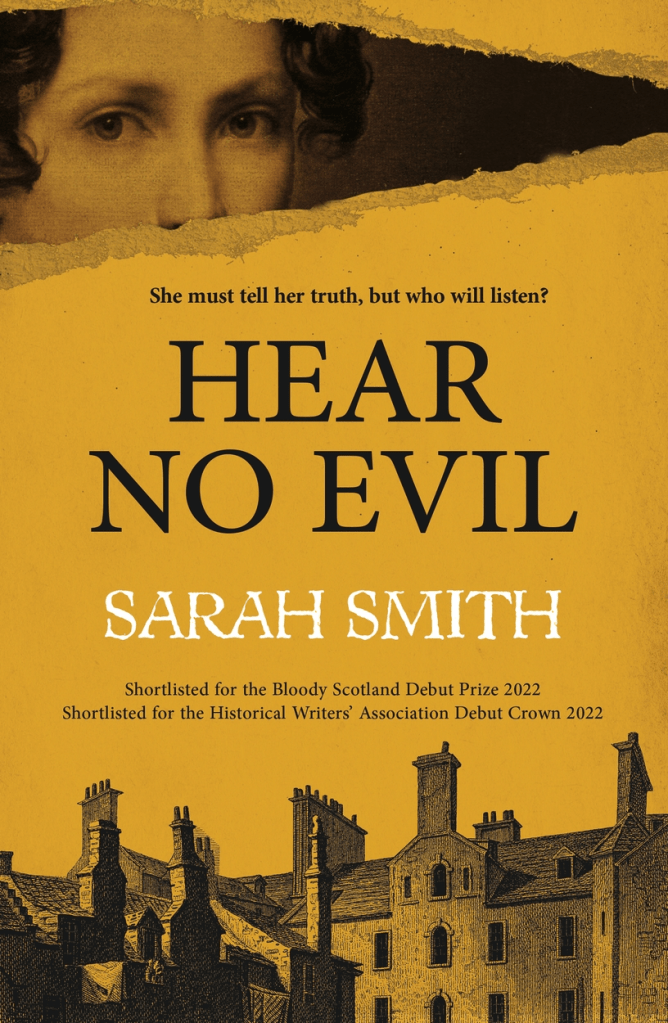
Robert’s quest means gaining Jean’s trust. The novel succeeds in showing, through their mutual respect, her complexity and humanity. Fledgling sign language is subtly used to make Jean more than a victim.
The mood of each city is sharply drawn. From Edinburgh’s Tollbooth Prison, Robert trudges the wynds, closes and cold, stone streets to grand squares and chambers, meeting judges, professors and doctors concerned with Jean’s case. In Glasgow we see dirt-poor people teeming around the black river, the bridges and the maze of vennels in the Briggait, Saltmarket and Candleriggs, thatched roofs jammed among stone tenements.
As the truth about Jean’s child unfolds, Hear No Evil offers not just a personification of how disabled people were undervalued in earlier times, but an understanding of how long the journey to full equality remains today.
A Prince flees – in drag
Alan Warner subtitles his tenth book, Nothing Left to Fear From Hell (Polygon, 2023), “A Surreal Chronicle”. Its legendary characters, events and locations – Prince Charles Edward Stuart and a band of Jacobite followers, including Flora MacDonald, fleeing to the Hebrides – are shown with lively, often filthy and foul, realism.
Desperate and hunted by thousands of redcoats, the Prince – “the pale man” – and crew stay remarkably spirited as they evade capture, despite the £30,000 English pounds jackpot to any who would betray him. The thrill of the chase makes this short book an exciting adventure as well as a highly original picture of what, in the wake of Culloden, that famous getaway over the seas was really like.
Warner revitalises true-life characters – Neil MacEachain, Irish captains O’Neil and O’Sullivan, Flora and family – with punchy, authentic dialogue and descriptions.The Prince is the star – flawed, vain yet intrepid against the odds – holding fast to his cluster of supporters.
He cuts a far from princely picture. He vomits, shits and pishes on the first island they land. The rank conditions forced upon him and his party are depicted in lurid detail. They are bitten by “terror mitches”, as the Prince calls them. Ever-increasing numbers of the insects are sketched on pages between each chapter.
We know how the story ends, but the speed of action and threat of fatal arrest keep the narrative gripping. Though grim, their plight is laced with banter and inuendo. Much fun surrounds the Prince’s hopeless attempts to pass as an Irish seamstress. Not the great pretender after all, he fidgets with the wig and vexes at his lack of bosom. His drag name is Betty Burke, but he wouldn’t trouble the scorer on Ru Paul.
This novella is part of Polygon’s series of Darkland Tales,fictional retellings of stories from history, myth and legend by Scottish authors. First was Rizzio (2021)by Denise Mina, a reimagining of the murder of the private secretary to Mary Queen of Scots. Hex (2022) – witchcraft and misogyny – is by Jenni Fagan whose fantastical Luckenbooth (Cornerstone) I loved. It sort of does for Edinburgh what Alasdair Gray did in Lanark for Glasgow (Unthank). In October this year, the fourth Darkland Tale, Colomba’s Bones by David Greig, will be published – the bloody killing of a monk on ninth-century Iona.

Readable mystery thrillers
Another rich version – vision – of 1800’s Edinburgh comes from Ambrose Parry, pen name of Marisa Haetzman and husband Christopher Brookmyre. There are now five books in the Raven and Fisher series from The Way of All Flesh (Canongate Books, 2018) to The Spendthrift and The Swallow (2023). This last one (title from Aesop’s Fables) is actually a prelude to book four, Voices of the Dead, published next week.
Dr Will Raven and would-be medic Sarah Fisher delve into the city’s dark secrets to solve strange deaths. Haetzman is an anaesthetist; I enjoyed all the detail about chloroform in The Art Of Dying (book two, 2019). The medical history and research are scrupulous, as compelling as the plots and the evocation of old Edinburgh, in these highly readable mystery thrillers.
Rilke rides again
Finally, a series (well, two books – twenty years apart – with the same milieu and characters) set in present-day Glasgow. Louise Welsh’s debut, The Cutting Room (Canongate, 2002) was a breakthrough novel, garlanded with awards.
From the unlikely premise of a house clearance, Welsh conjures up, through auctioneer-turned-detective Rilke, a weird world of bent coppers, porn, drugs and death. Like Marlowe in Raymond Chandler’s crime noir, Rilke is a loner with an internal voice that glues him to the reader throughout.
In The Second Cut (2022), Rilke rides again, but now inhabits a post-Covid Glasgow that brews an even stronger mix of squalor and humour, with orgies, asylum-seekers enslaved, a dead dog and the suspicious death of a friend. Welsh gets Glasgow – I found Rilke’s dander round the Trongate endearing in its familiarity. This long-anticipated sequel is worth the wait.
Paul Bassett
Glasgow
June 2022
 STAGE LEFT